






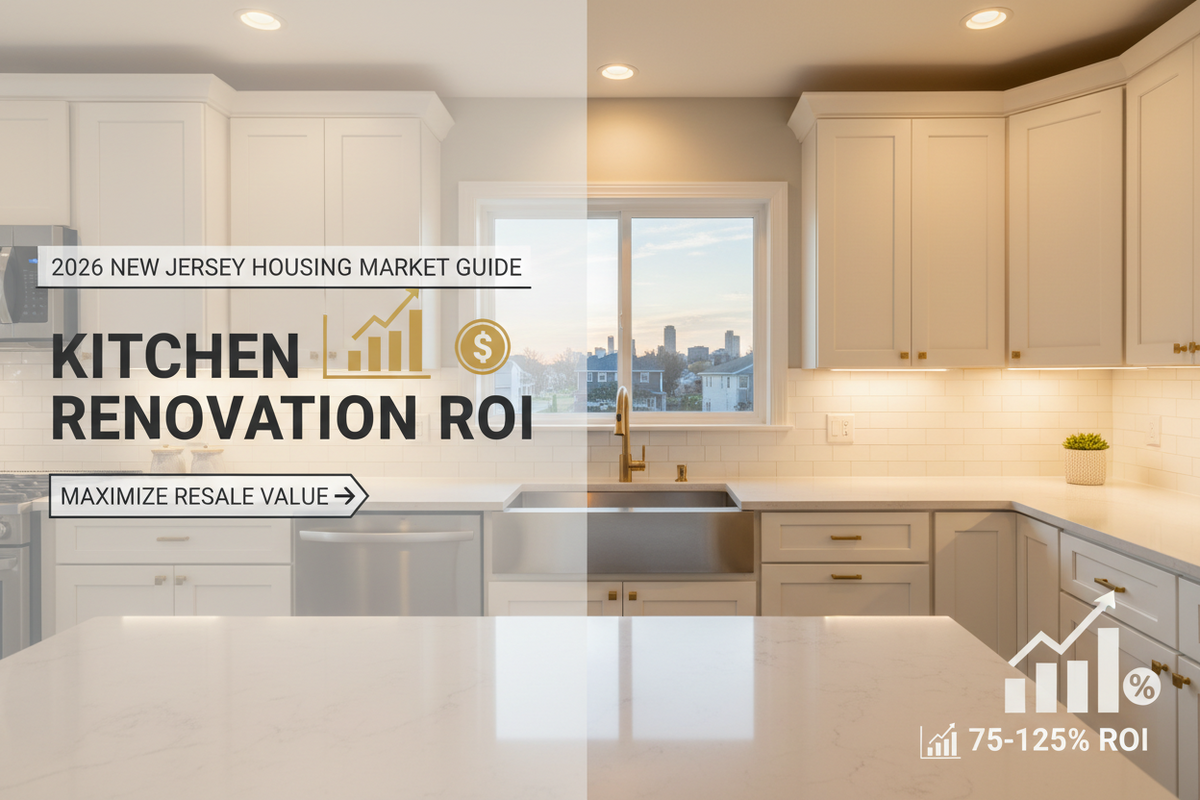
If you're spending $50,000 (or $250,000) on a kitchen renovation, you deserve an honest answer to one question: how much of that comes back when you sell? After working with hundreds of NJ homeowners across the full spectrum of renovation budgets, and watching many of them list their homes within 3–7 years after the work, we have a clear picture of what actually adds value in the New Jersey housing market versus what's a personal lifestyle choice that doesn't return at sale.
This isn't national-average ROI data. It's specifically what we've observed in NJ markets across Bergen, Essex, Hudson, Union, and Westchester counties. Here's the honest breakdown of where renovation dollars work hardest, and which upgrades look good but rarely pay back.
The General ROI Reality (NJ-Specific 2026 Numbers)
Across the full range of kitchen renovations, here's what typically recoups at NJ resale:
| Renovation Tier | NJ Resale Recovery | Best Use Case |
|---|---|---|
| Budget refresh ($18K–$32K) | 85–110% | Selling within 18 months; rental properties |
| Mid-range ($38K–$75K) | 70–90% | Selling within 3–5 years; primary residences |
| Premium ($85K–$140K) | 55–75% | Long-term residence (7+ years) |
| Luxury ($150K–$300K) | 40–60% | Forever homes; high-end markets |
| True luxury ($325K+) | 25–45% | Lifestyle decisions in luxury markets only |
The pattern is consistent: lower-tier renovations return higher percentages because they bring outdated kitchens to current market expectations. Higher-tier renovations deliver lifestyle benefits that exceed market premium.
Highest-ROI Kitchen Upgrades in NJ (2026)
1. Cabinet Refacing or Painting (300–500% ROI)
If your existing cabinets are structurally sound but visually dated, refacing or professional painting updates the kitchen at relatively low cost. We've seen $2,500 cabinet paint jobs add $8,000–$15,000 to NJ sale prices.
Investment: $2,000–$8,000
Returns at sale: $7,000–$25,000
2. Quality Hardware Replacement (300–400% ROI)
Replacing dated hardware with current brushed brass or matte black pulls signals "recently updated" to buyers. It is a small investment with a visible result.
Investment: $300–$1,500
Returns at sale: $2,000–$5,000
3. Contemporary Backsplash (200–400% ROI)
Replacing dated backsplash with vertical subway tile, zellige, or large-format porcelain creates strong listing photos and immediate buyer appeal.
Investment: $2,500–$6,000
Returns at sale: $8,000–$20,000
4. New Quartz Countertops (150–250% ROI)
Replacing laminate or dated tile counters with current quartz is one of the most impactful single upgrades. Buyers in NJ markets expect stone counters in any home above $400K.
Investment: $3,500–$7,500
Returns at sale: $7,000–$15,000
5. Pendant Lighting Upgrade (200–350% ROI)
Replacing dated overhead lighting with current pendant fixtures over the island noticeably improves kitchen photos. Critical for listing photography.
Investment: $800–$2,500
Returns at sale: $2,500–$6,500
Strong-ROI Mid-Range Upgrades (NJ 2026)
6. Full Cabinet Replacement (Mid-Range)
Replacing dated cabinets with Fabuwood or TSG cabinets delivers strong returns in homes priced $500K–$1.2M. Critical for NJ resale unless cabinets can be refaced.
Investment: $11,000–$22,000
Returns at sale: $15,000–$28,000 (70–85% recovery)
7. Energy Star Appliance Package
Upgrading to current Energy Star appliances (Bosch, KitchenAid, LG) signals modern, efficient, low-maintenance home. Particularly valuable in NJ markets where utility costs are high.
Investment: $6,000–$12,000
Returns at sale: $5,000–$10,000 (70–85% recovery)
8. Kitchen Island Addition
Adding a functional kitchen island where one didn't exist is one of the highest lifestyle and resale-value moves in older NJ homes. Open-concept floor plans demand islands.
Investment: $8,000–$22,000
Returns at sale: $10,000–$25,000 (75–90% recovery)
9. Modern Lighting Plan
Full kitchen lighting redesign (recessed + under-cabinet + pendant + accent) dramatically improves daily function and listing appeal.
Investment: $2,500–$5,500
Returns at sale: $3,500–$7,500 (75–90% recovery)
10. Open-Concept Wall Removal
Removing a wall between a closed kitchen and adjacent living space opens up older NJ colonials. Major work, but consistently strong ROI in suburban markets.
Investment: $8,000–$25,000 (including structural work)
Returns at sale: $12,000–$35,000 (90–115% recovery)
Lower-ROI Upgrades (Lifestyle Choices, Not Investments)
These improvements deliver real daily value but rarely return their full cost at NJ resale:
11. Premium Appliances (Wolf, Sub-Zero, Miele)
The $20,000–$40,000 appliance upgrade rarely adds proportional sale price. Buyers want "appliances included"; they don't always pay premiums for specific brands.
Investment: $20,000–$45,000
Recovery: 40–60%
12. Waterfall Countertops
Dramatic visual impact, strong lifestyle benefit. Resale recovery depends on the market: strong in $1M+ NJ homes, modest in mid-market.
Investment premium: $3,000–$8,000
Recovery: 60–80% in upper markets, 30–50% in mid-market
13. Smart Kitchen Technology
AI ranges, smart fridges, Servo-Drive cabinets deliver lifestyle benefits but minimal resale premium in most NJ markets.
Investment: $5,000–$25,000
Recovery: 30–50%
14. Custom Millwork Details
Beautiful but invisible to most buyers. Custom range hood treatments, detailed moldings, hidden appliance garages add minimal resale value despite significant cost.
Investment: $5,000–$30,000
Recovery: 25–45%
15. Specialty Stone Counters
Exotic quartzite or rare marble adds personal joy but minimal market premium. Buyers value "stone counter"; most don't differentiate between Mont Blanc and Calacatta in their valuation.
Investment premium over standard quartz: $4,000–$15,000
Recovery: 30–60%
The ROI Mistakes That Cost NJ Sellers Money
Over-personalizing finishes. A custom kitchen designed perfectly for your family taste may not match the next buyer. Stick to broadly-appealing palettes (whites, woods, sage) for resale-focused renovations.
Over-improving for the neighborhood. A $150,000 kitchen in a neighborhood where comparable homes sell at $600K won't return the investment. Match renovation scale to neighborhood expectations.
Trendy choices that date fast. Bold colored cabinets, dramatic specialty hardware, and very-current trends date quickly. Stick to materials and styles with 10–15 year aesthetic durability.
Skipping permits. Unpermitted work creates buyer hesitation, insurance issues, and frequently requires retrofit work before sale. Always pull permits.
Renovating right before selling. Brand-new renovations within 12 months of sale often don't fully recoup costs because buyers question motivation. Renovate either to stay or 2–3 years before listing.
NJ Market Tier Strategy
| Home Value Tier | ROI-Optimal Renovation Strategy |
|---|---|
| Under $400K | Cosmetic refresh, painted cabinets, new hardware. Budget $18K–$28K max. |
| $400K–$700K | Full mid-range renovation. Fabuwood cabinets, quartz, mid-range appliances. Budget $40K–$65K. |
| $700K–$1.2M | Premium mid-range. Better cabinets, quartzite, mid-range premium appliances. Budget $60K–$95K. |
| $1.2M–$2M | Premium renovation. Quality custom or KraftMaid, premium stone, Wolf/Sub-Zero, custom millwork. Budget $90K–$160K. |
| $2M+ | Full luxury renovation expected by buyers. Budget $150K–$400K+. |
Geographic ROI Variations Within NJ
Different NJ markets respond to upgrades differently:
Strong markets for premium renovations: Saddle River, Englewood Cliffs, Tenafly, Short Hills, Greenwich. Buyers expect and pay for quality.
Strong markets for mid-range: Montclair, Maplewood, Ridgewood, Park Slope. Buyers value updated kitchens but don't necessarily pay luxury premiums.
Markets where cosmetic refreshes excel: Most of the lower price-point NJ market under $500K. Cosmetic work delivers highest ROI; full premium renovations don't fully recoup.
Frequently Asked Questions
Q: Should I renovate before selling or sell as-is?
For dated kitchens, even a $3K–$5K refresh (paint, hardware, lighting) typically returns 2–3x at sale. For seriously dated kitchens, consider a $20K–$30K refresh. Skip major renovations within 12 months of sale; buyers question motivation.
Q: How long does kitchen renovation ROI last?
Most ROI calculations assume sale within 3–7 years. After 10+ years, even high-quality renovations begin showing age and need updating. Plan major renovations for either long-term residence or near-term sale, not 15-year holds.
Q: Does adding a kitchen island always add value?
In NJ markets, yes, if your kitchen has space for one and currently lacks one. Adding an island to a kitchen that already has one rarely returns its cost.
Q: Are kitchen renovations the best home improvement ROI?
Among the best, alongside bathroom renovations and entry-door replacement. Kitchens typically beat bathrooms for primary residence ROI; bathrooms can win for rental properties.
Q: Will a $40K kitchen renovation add $40K to my sale price?
Probably not in most NJ markets. Expect $28K–$36K added value. The remaining $4K–$12K is the cost of years of enjoying a better kitchen.
The Bottom Line
The highest-ROI kitchen renovations in NJ are cosmetic refreshes ($2K–$8K) and mid-range full renovations ($40K–$75K). Premium and luxury renovations recover less proportionally but deliver lifestyle benefits that compound over years of daily use.
Strategy for maximum ROI: match your renovation scale to your neighborhood, prioritize cabinets/counters/lighting/hardware over flashy upgrades, and choose materials with 10–15 year aesthetic durability rather than short-lived trends.
Home Craft Studio designs NJ and NY kitchen renovations with both lifestyle benefits and resale value in mind. Visit homecraftstudio.com to plan a renovation optimized for your goals.
Share:
How Much Does a Kitchen Renovation Really Cost in NJ & NY in 2026? Complete Pricing Guide