





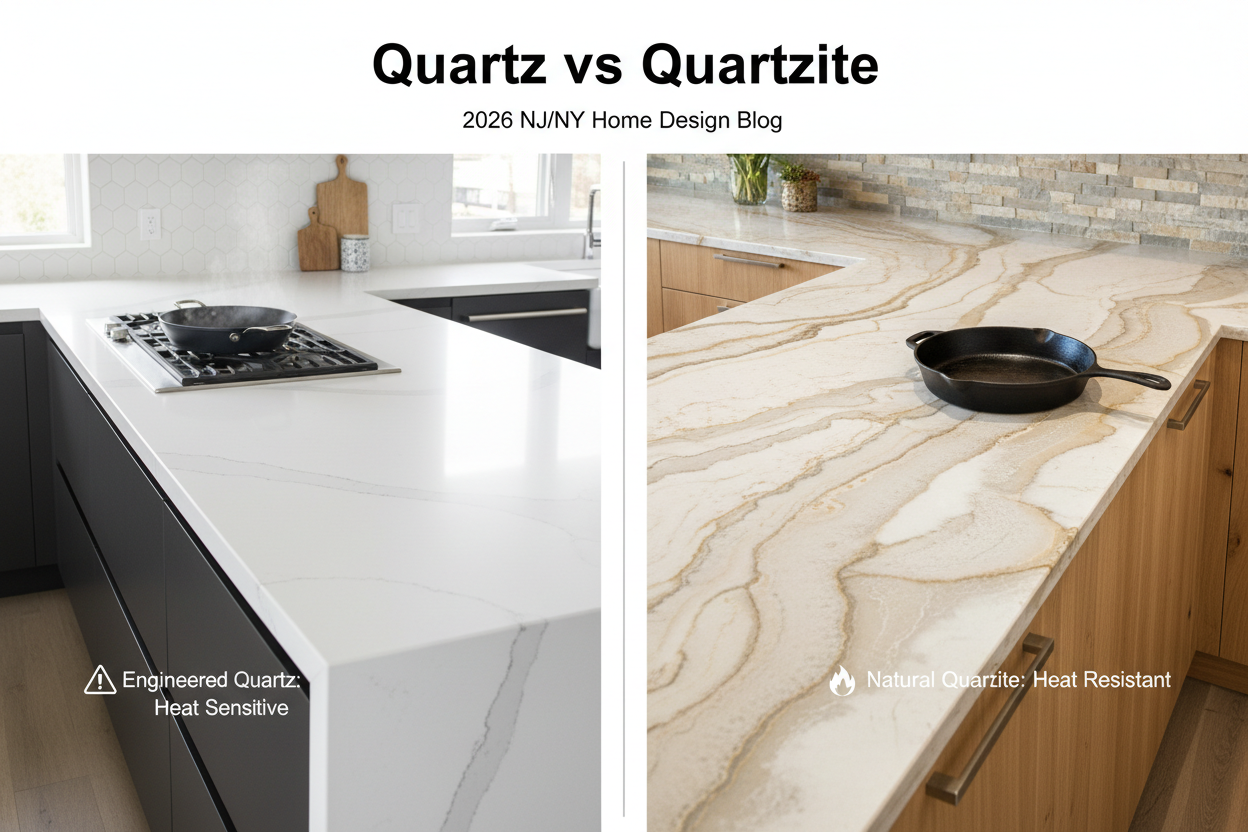
Walk into any stone yard from Paterson to Long Island City and you'll hear two words tossed around almost interchangeably: quartz and quartzite. They sound nearly identical, look similar in showroom samples, and both promise "the best countertop for your kitchen." But they couldn't be more different — and choosing the wrong one for your lifestyle is one of the most expensive mistakes a NJ homeowner can make in 2026.
We've installed both surfaces in hundreds of tri-state kitchens over the years. Here's the honest, real-world comparison nobody else will give you.
What They Actually Are
This is where confusion starts. The names are deceptively similar but the materials are completely different.
Quartz is engineered stone. It's made from roughly 90% crushed natural quartz mineral mixed with 10% polymer resins and pigments, then pressed into slabs. Brands you know — Caesarstone, Silestone, Cambria, MSI Q — all make quartz. The result is a man-made surface that looks like stone but is engineered for performance.
Quartzite is 100% natural stone. It starts as sandstone deep in the earth, then transforms over millions of years under heat and pressure into a dense, crystalline rock. Each slab is one-of-a-kind, quarried from places like Brazil, Italy, and India. Popular names: Taj Mahal, White Macaubas, Calacatta Macchia Vecchia, Mont Blanc.
That single difference — engineered vs natural — drives every other decision.
Visual Differences (What You'll Actually See)
In the showroom, quartz and quartzite can look almost identical from across the room. Up close, the differences become obvious.
Quartz has consistent, repeating patterns. Veining is printed or engineered into the slab. Two slabs of the same color look essentially the same. This consistency is a feature, not a bug — what you see in the sample is exactly what you get on your counter.
Quartzite has organic, unpredictable veining that flows differently across every slab. The crystals catch light. You'll see depth and translucency that engineered stone can't replicate. No two quartzite slabs are alike, which means you'll need to visit the stone yard and personally select your slab.
For homeowners who want a "perfect, predictable" look: quartz.
For homeowners who want a one-of-a-kind statement: quartzite.
Durability: The Real-World Test
This is where most articles get it wrong by reciting Mohs hardness numbers. Here's how each performs in an actual NJ family kitchen.
Heat resistance: Quartzite wins by a wide margin. It can handle hot pans straight from the stove. Quartz cannot — the resin binder discolors and warps at temperatures above 300°F. If you're the kind of cook who pulls a sheet pan out of the oven and sets it down without thinking, quartz will burn.
Stain resistance: Quartz wins. Because it's non-porous, red wine, coffee, turmeric, and lemon juice wipe right off. Quartzite, while less porous than marble, still needs to be sealed once a year. Spills should be wiped quickly.
Scratch resistance: Quartzite wins. It's harder than quartz on the Mohs scale (7 vs 6–6.5). You can technically cut directly on quartzite without damaging it — though we still recommend a cutting board. Quartz scratches more easily, particularly with knives.
UV resistance: Quartzite wins. Quartz can yellow or fade in direct sunlight over years — important for kitchens with big south-facing windows (common in newer Westchester and Long Island builds).
Chip resistance: Quartz wins. The resin gives it slightly more flexibility, so edges are less prone to chipping at impact points.
Cost Breakdown for NJ/NY Kitchens (2026)
Here's what you'll actually pay installed in a typical 10x12 NJ kitchen (about 45 sq ft of counter):
| Material | Per Sq Ft Installed | Total for 45 Sq Ft |
|---|---|---|
| Mid-range quartz (MSI Q, Silestone basics) | $65–$95 | $2,900–$4,300 |
| Premium quartz (Cambria, Caesarstone) | $95–$140 | $4,300–$6,300 |
| Designer quartz (Calacatta-style high-end) | $130–$180 | $5,800–$8,100 |
| Mid-range quartzite (Taj Mahal, White Macaubas) | $90–$130 | $4,000–$5,800 |
| Premium quartzite (Mont Blanc, Cristallo) | $130–$200 | $5,800–$9,000 |
| Exotic quartzite (Patagonia, Azul Macaubas) | $200–$400+ | $9,000–$18,000+ |
For most NJ kitchens, the practical comparison is mid-range quartz ($3,500) vs mid-range quartzite ($4,800) — about a $1,300 difference for the natural alternative.
Maintenance Reality Check
Quartz maintenance:
- Daily: wipe with mild dish soap
- Annual: nothing
- Lifetime: nothing
Quartzite maintenance:
- Daily: wipe with pH-neutral cleaner (not vinegar, not citrus)
- Annual: re-seal with a quality stone sealer ($30 product, 20 minutes of work)
- Lifetime: occasional professional polishing if you want to refresh the shine
If "low-maintenance" is at the top of your priority list, quartz wins. If you're willing to spend 30 minutes once a year, quartzite isn't significantly more demanding.
Which Wins for Which Lifestyle?
After years of installations, here's the honest match-up:
Choose quartz if you:
- Have young kids and prioritize stain resistance
- Want a low-maintenance counter you never think about
- Prefer consistent, predictable patterns
- Don't cook with searing-hot pans regularly
- Want lower cost without sacrificing modern looks
Choose quartzite if you:
- Want a one-of-a-kind, natural stone with character
- Cook seriously and pull hot pans out of the oven daily
- Live in a south-facing kitchen with lots of sun
- Value the depth and translucency of natural stone
- Plan to stay in the home 10+ years (the resale story is strong)
NJ/NY-Specific Considerations
Hardness of NJ water. Our regional water is moderately hard. Both surfaces handle it fine, but mineral deposits show more on darker quartzite. Wipe spills around faucets within a day or two.
Older home structural concerns. Quartzite slabs typically weigh 50–80 lbs per square foot. If you're renovating a pre-1970 NJ home, your contractor may need to confirm the cabinets and subfloor can support the load. Quartz weighs about the same, so this isn't a deciding factor.
Stone yard access. The tri-state area has excellent stone yards — Stone Boutique in Fairfield, Aria Stone in Brooklyn, Marble Systems in New York. Visit two or three in person before deciding. Showroom samples never capture the full slab.
Common Mistakes to Avoid
Treating quartz like quartzite (or vice versa). A client recently set a hot saucepan on her brand-new Caesarstone quartz counter, expecting it would behave like natural stone. The discoloration is permanent. Know your material.
Skipping the slab selection. For quartzite, never order from a sample alone. The slab you receive will look different from the 6x6 inch sample. Always visit the yard.
Falling for "marble look" quartz at premium prices. High-end quartz that mimics Calacatta marble can cost as much as actual quartzite. If you want that look and you're paying $140/sq ft anyway, consider real stone.
Cheap fabricators. A $80 quartzite slab installed by a poor fabricator looks worse than a $50 quartz slab installed expertly. Vet your fabricator more carefully than your stone.
Frequently Asked Questions
Q: Is quartzite worth the extra cost?
For most NJ homeowners cooking real meals at home, yes. The heat resistance alone often justifies the $1,000–$2,000 premium. For light cooks and aesthetic-only kitchens, quartz is the smarter buy.
Q: Can quartzite chip easily?
Sharp impacts can chip the edges, especially on bullnose or ogee profiles. We recommend a simple eased edge for quartzite to minimize chip risk.
Q: Will quartz match my marble look?
Modern quartz from Cambria, Caesarstone, and MSI does an excellent job mimicking Calacatta and Carrara marble. But it lacks the depth — you can tell the difference up close. Beautiful, but not identical.
Q: How often does quartzite really need to be sealed?
Once a year for most NJ kitchens. Lighter, more porous quartzite (like White Macaubas) may need twice yearly. Darker, denser quartzite (like Mont Blanc) can stretch to 18 months.
Q: What about marble?
Marble is gorgeous but stains and etches from acidic foods (lemons, vinegar, tomato sauce). For a primary kitchen with kids, we recommend quartz or quartzite instead. Save marble for a baker's island or bathroom.
The Bottom Line
Quartz and quartzite are different products for different homeowners — they just happen to share four letters. For NJ and NY families who want low-maintenance consistency, modern quartz from Cambria, Caesarstone, or MSI delivers beautifully. For homeowners who want natural character, heat resistance, and a one-of-a-kind slab, quartzite is worth every penny of the premium.
Don't let a sales associate push you toward whichever has more inventory. Choose based on how you actually live in your kitchen.
Home Craft Studio works with stone yards across NJ and NY to help homeowners select the right countertop for their lifestyle. Visit homecraftstudio.com to schedule a stone yard tour.
Share:
How to Plan Your Spring Kitchen Renovation: A Step-by-Step Budget Guide for NJ Homeowners
Smart Kitchen Revolution: AI-Powered Appliances & Touch-to-Open Cabinets for 2026 Homes