




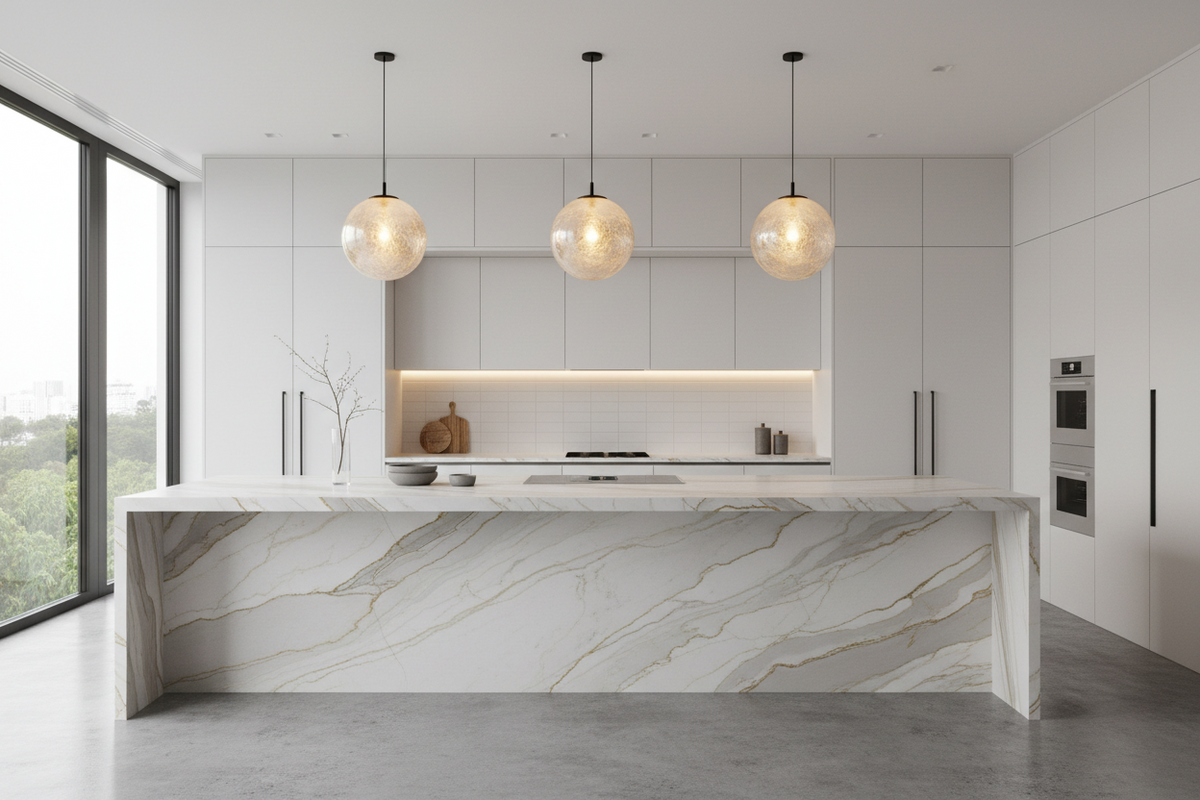
The waterfall countertop is one of those design moves that looks expensive even to people who can't articulate why. Stone flows continuously from the top of the island, over the edge, and all the way to the floor — a single visual gesture that transforms a standard kitchen island into a sculptural centerpiece. For years it lived in luxury real estate listings and high-end magazine spreads. In 2026, waterfall countertops have arrived in mainstream NJ and NY kitchen renovations.
We've fabricated and installed waterfall countertops in dozens of homes across the tri-state area — from full-marble dramatic moments in Saddle River to quiet quartz waterfalls in Hoboken brownstones. Here's the complete 2026 design guide: how to choose the right stone, what it actually costs, and the technical decisions that separate a stunning waterfall from a disappointing one.
What a Waterfall Countertop Actually Is
A waterfall countertop is when the kitchen island (or peninsula) is finished with stone on three planes: the horizontal top, plus both vertical sides cascading down to the floor. The grain or veining of the stone is matched across the corner so the pattern appears to flow continuously — like a waterfall, hence the name.
The technical achievement is in the seam. A skilled fabricator mitres the corner at 45 degrees, then book-matches the slab so the veining lines up perfectly. Done well, the corner is almost invisible. Done poorly, it looks like two separate slabs taped together.
Why Waterfall Counters Took Over in 2026
Three forces converged:
1. Open-concept floor plans need visual anchors. A waterfall island becomes the defining architectural element of an open kitchen-living space — something to look at from the sofa, not just functional storage.
2. Stone fabrication technology has gotten dramatically better. The miter cuts and slab matching that were artisan-level in 2018 are now routine for any quality fabricator with modern CNC equipment.
3. Buyers expect them in upper-market homes. In NJ and NY listings above $900K, a waterfall island is increasingly the baseline rather than a luxury. Without one, the kitchen feels under-designed.
Best Stone Options for Waterfall Countertops in 2026
1. Quartzite (The Top Choice for Drama)
Natural quartzite — particularly Mont Blanc, Taj Mahal, or White Macaubas — is the gold standard for waterfall installations. The dramatic veining of natural stone matters more in a waterfall because you see it across multiple planes. The visual depth that quartzite offers can't be replicated by engineered stone.
Best for: Statement kitchens, larger islands, premium-tier renovations.
Cost: $130–$220 per sq ft installed (waterfall premium of 30–50% over standard counters).
2. Calacatta Marble (The Classic Luxury Move)
For homeowners who prioritize visual beauty over practical maintenance, Calacatta marble — with its dramatic gray veining on white background — is the timeless waterfall choice. Yes, it etches. Yes, it stains. It's still the most aspirational stone you can install.
Best for: Show kitchens, dramatic primary spaces, clients who accept stone patina as character.
Cost: $140–$280 per sq ft installed.
3. Premium Quartz (The Practical Choice)
Brands like Cambria, Caesarstone, and Silestone now offer marble-look quartz with dramatic veining specifically designed for waterfall applications. The lower maintenance and consistency make this the smarter choice for family kitchens.
Best for: Busy family kitchens, primary cooking spaces, clients who want the look without the maintenance.
Cost: $95–$170 per sq ft installed.
4. Soapstone (The Modern Minimalist Choice)
For contemporary kitchens with darker palettes, soapstone waterfall counters create a quiet, sophisticated look. Soapstone darkens and develops patina over time — a feature, not a bug, for the right client.
Best for: Modern, minimalist kitchens; clients who appreciate aging materials.
Cost: $110–$180 per sq ft installed.
5. Porcelain Slab (The Underrated Option)
Large-format porcelain slabs (Neolith, Dekton, Florim) in marble looks offer the waterfall aesthetic with bulletproof durability — heat, scratch, and stain resistant in ways no natural stone can match.
Best for: High-use kitchens, modern designs, clients prioritizing performance.
Cost: $110–$190 per sq ft installed.
The Critical Fabrication Details
Most waterfall failures we see come from fabricator shortcuts. The details that matter:
Book-matched veining. The pattern at the top-edge corner must continue down the vertical face. This requires the fabricator to cut the slab carefully and book-match (mirror) the adjacent piece. Without book-matching, the corner looks like an obvious seam.
True 45-degree miter. The corner cut should be exactly 45 degrees, with the two pieces meeting at a single sharp line. Cheap fabricators use a 90-degree edge with a glued cover — it looks wrong from any angle.
Full-thickness slab on the vertical face. Some installations cheat by using 3cm horizontal stone but only 2cm or backsplash material for the vertical pieces. The look is inconsistent. Insist on matching thickness throughout.
Stone selection at the yard. For waterfall installations, you must visit the stone yard and personally select your slabs (typically 2–3 needed). Veining placement matters far more than for standard counter applications.
Design Considerations
Single-sided or Double-sided Waterfall?
The classic waterfall flows down both ends of the island. A single-sided waterfall (stone cascading down only one side) is a more affordable option that still adds drama — particularly when the visible side faces an open living space and the other side is hidden against a wall or doorway.
Continuation to the Backsplash?
A premium 2026 move: continuing the same stone up the wall as a slab backsplash. The stone effectively wraps the kitchen — floor-to-counter on the island, counter-to-ceiling on the wall. Stunning but expensive ($8,000–$25,000 added).
Edge Profile
Waterfall counters look best with simple, clean edges — eased (slightly rounded) or square. Decorative profiles (ogee, bullnose) distract from the slab's visual flow and look dated.
Cost Reality for NJ/NY Waterfall Kitchens (2026)
A waterfall countertop adds 30–70% to standard countertop costs because of the additional stone (you need 3 planes instead of 1), the fabrication labor (precise mitering and matching), and the slab matching premium (you need to buy 2–3 slabs to get matching veining).
| Project | Standard Counter Cost | Waterfall Counter Cost | Waterfall Premium |
|---|---|---|---|
| Mid-range quartz island (typical NJ) | $3,500–$5,500 | $6,500–$9,500 | +$3,000–$4,000 |
| Premium quartzite island | $5,500–$9,000 | $10,500–$16,000 | +$5,000–$7,000 |
| Marble or exotic stone island | $8,000–$15,000 | $15,000–$28,000 | +$7,000–$13,000 |
For most NJ homeowners considering a waterfall, the $3,000–$7,000 premium delivers some of the highest visual impact per dollar in the entire kitchen renovation.
Common Waterfall Countertop Mistakes
Choosing a stone with no movement. Solid-color quartz or stone with minimal veining looks bland on a waterfall — the whole point is to showcase pattern across three planes. Pick stone with personality.
Hiring the cheapest fabricator. Waterfall installations require precise mitering and slab matching. Save money on the stone if needed, but never on the fabricator.
Wrong scale for the kitchen. A waterfall island in a 100 sq ft kitchen often overwhelms the space. Reserve waterfall installations for islands at least 6 feet long with a kitchen at least 150 sq ft.
Hidden waterfall sides. A double-sided waterfall where one side faces a wall is wasted stone and money. Either the waterfall is visible or skip it.
Mismatched countertop and waterfall. Using one stone for the horizontal counter and a different one for the waterfall vertical (to save money) almost always looks wrong. Stick to a single material.
Frequently Asked Questions
Q: How long does a waterfall countertop installation take?
Add 1–2 weeks to standard countertop timing. Template, fabrication, slab matching, and the more delicate installation process all take longer than a standard counter install.
Q: Can I add a waterfall to my existing island?
Technically yes, but the cost rarely justifies it. The cost of retrofitting (removing existing counter, designing the waterfall, fabrication, install) approaches the cost of a full new island. If you're considering a waterfall retrofit, often it's better to do a more complete island redesign.
Q: Does a waterfall counter hurt resale value?
The opposite — it boosts resale value in NJ markets above $700K. Tasteful waterfall counters signal premium design to buyers. The only resale risk is choosing a polarizing stone (very bold or unusual material).
Q: Are waterfall counters durable?
The vertical sides are actually more durable than the horizontal top because they don't experience the same heat, knife, and acid exposure. The horizontal top behaves like any standard counter in the same stone.
Q: Will my dog/kids damage the vertical sides?
The vertical sides are vulnerable to impact damage from stools, vacuums, and pet collisions. Choose stones with chip resistance (porcelain or premium quartz) for high-traffic family kitchens.
The Bottom Line
The waterfall countertop is one of the highest-impact, most cost-efficient drama moments you can add to a 2026 NJ or NY kitchen. The $3,000–$7,000 fabrication premium delivers visual impact that competes with much more expensive renovation choices — and signals premium design to buyers if you ever sell.
The keys to success are simple: pick a stone with character, find an experienced fabricator who can book-match veining, and design the island at a scale that supports the gesture. Skip these, and a waterfall counter disappoints. Get them right, and it becomes the defining feature of the room.
Home Craft Studio designs and installs waterfall countertops across NJ and NY with experienced stone fabrication partners. Visit homecraftstudio.com to explore stone options at our showroom.
Share:
Fall Kitchen Renovation Planning: Why September Is the Best Month to Start Your NJ Remodel