



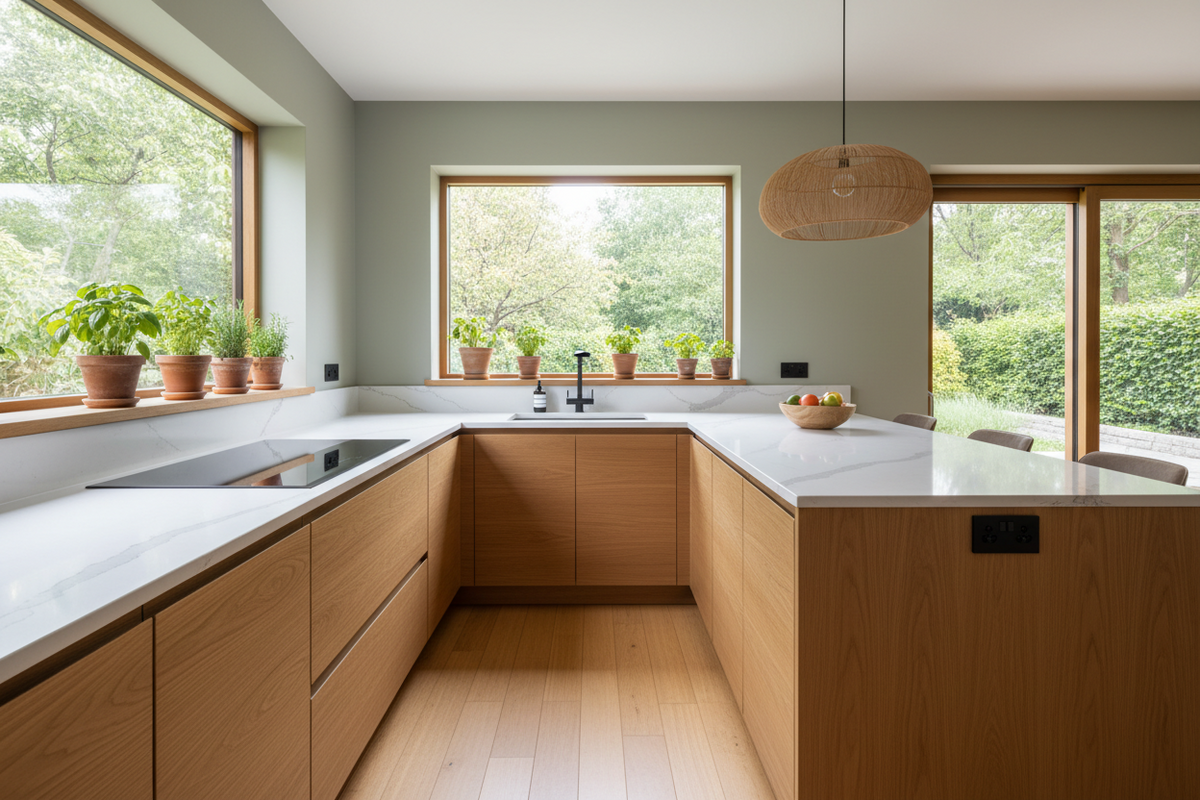
The phrase "eco-friendly renovation" used to come with a tradeoff — you'd accept slightly worse materials, slightly lower aesthetic, and slightly higher cost in exchange for environmental peace of mind. Not anymore. In 2026, sustainable kitchen materials match (and sometimes outperform) conventional options on every dimension that matters: durability, appearance, cost, and lead time.
For NJ and NY homeowners increasingly aware of indoor air quality, climate impact, and long-term home health, the eco-friendly kitchen has moved from niche to mainstream. Here's how to build a sustainable kitchen that doesn't compromise on style or budget — and what to actually prioritize when "green" labels get marketing-heavy.
What "Eco-Friendly Kitchen" Actually Means in 2026
The term gets overused, so let's get specific. A genuinely sustainable 2026 kitchen prioritizes four things:
- Indoor air quality — Low-VOC finishes, formaldehyde-free cabinetry, healthier paints
- Material sourcing — FSC-certified wood, recycled content in surfaces, locally manufactured when possible
- Energy efficiency — Energy Star appliances, LED lighting, induction over gas
- Longevity — Materials that last 25+ years reduce future renovation waste
The most impactful of these is often #1 — indoor air quality. A kitchen finished in low-VOC paints, formaldehyde-free cabinets, and low-VOC adhesives offgases dramatically less than a conventional kitchen, particularly in the first 18 months after install. For families with young children, asthma sufferers, or anyone working from home, this is a quality-of-life upgrade as much as an environmental one.
Sustainable Cabinet Options
The cabinet box is where the biggest sustainability decisions get made — most of a kitchen's environmental footprint comes from cabinetry.
1. CARB Phase 2 Compliant or NAUF Cabinets
The standard to look for: CARB Phase 2 (California Air Resources Board) certified, or better, NAUF (No Added Urea-Formaldehyde) cabinetry. Fabuwood and Cubitac both offer CARB Phase 2 compliant cabinets in their standard lines. NAUF construction goes further by using formaldehyde-free MDF and plywood adhesives.
Cost premium over standard: typically minimal (5–10%) for CARB Phase 2; 15–25% for fully NAUF.
Forevermark (TSG Cabinetry) is another line worth asking about here: the manufacturer states that all of its cabinets meet or exceed U.S. Environmental Protection Agency standards for emissions, and that several collections carry additional environmental certifications. Ask your dealer for the certification sheet covering the specific collection you are quoting rather than relying on a brand-level claim.
2. FSC-Certified Wood Cabinets
For solid wood cabinets, look for FSC (Forest Stewardship Council) certification — the gold standard for responsibly harvested wood. Wood-Mode and several smaller custom shops offer fully FSC-certified options.
3. Reclaimed Wood Cabinets
For homeowners willing to wait and pay a premium, reclaimed-wood cabinets (built from 19th-century barn wood, salvaged industrial wood, etc.) offer maximum sustainability and one-of-a-kind character. Sources like Pioneer Millworks and local NJ reclaimers supply material to custom shops.
Cost premium: 30–60% over standard custom cabinetry.
Low-VOC and Zero-VOC Finishes
Volatile Organic Compounds (VOCs) are chemicals that evaporate from paints, stains, and adhesives, contributing to indoor air pollution. Modern low- and zero-VOC products perform identically to conventional ones.
Brands worth knowing for 2026:
- Benjamin Moore Natura — Zero-VOC, zero-emissions paint with excellent durability
- Sherwin-Williams Harmony — Zero-VOC paint that also absorbs ambient VOCs
- AFM Safecoat — Specialty paints for the most chemically sensitive applications
- EcoStain — Plant-based wood stains for cabinets and trim
- Bona Traffic HD — Low-VOC floor finish; standard for high-traffic kitchens
For interior cabinet finishes, ask your fabricator for waterborne conversion varnishes rather than traditional solvent-based lacquers. Most quality factory-finished brands (Fabuwood, Cubitac, TSG) now use lower-VOC waterborne systems by default.
Green Countertop Options
Several countertop materials offer strong sustainability stories:
1. Recycled Glass Countertops (Vetrazzo, Curava, GlassWorks)
Made from up to 85% recycled glass embedded in concrete or resin binders. Stunning visual character, surprisingly durable, and a strong sustainability narrative.
Cost: $90–$160 per sq ft installed
2. Recycled Paper Composite (Richlite, PaperStone)
Made from compressed recycled paper and resin. Warm to touch, repairable, sustainably sourced. Less heat-resistant than stone — best for non-cooking areas.
Cost: $75–$130 per sq ft installed
3. FSC-Certified Wood Counters
Butcher block from FSC-certified hardwood is renewable, beautiful, and ages well. Best on islands or as accent surfaces rather than primary work zones.
Cost: $40–$95 per sq ft installed
4. Sustainably Sourced Stone
Some quarries (particularly newer operations in Vermont, Pennsylvania, and Canada) operate under stronger environmental standards than overseas alternatives. Ask your fabricator about sourcing.
5. Recycled-Content Quartz
Brands like IceStone and certain Caesarstone collections incorporate recycled glass and stone aggregates into their quartz formulations.
Energy-Efficient Appliances Worth the Premium
Not all Energy Star appliances are equal. The ones with the strongest 2026 case:
- Induction cooktops — ~40% more energy efficient than gas, faster heating, no indoor combustion pollution
- Heat pump dryers — Use ~50% less energy than conventional dryers (relevant for laundry adjacent to kitchen)
- Energy Star Most Efficient refrigerators — Look for the "Most Efficient" subset, not just standard Energy Star
- Dishwashers with soil sensors — Adjust water use to actual load dirtiness, saving 20–30% water
The induction cooktop conversation is particularly relevant in 2026 — health benefits (no indoor NO2 from gas combustion) and energy benefits both favor induction. We've installed many induction cooktops for NJ families converting from gas, and the universal feedback has been positive.
Cost Reality: What Does a Sustainable Kitchen Actually Cost?
| Tier | Cost Premium vs. Conventional |
|---|---|
| Light eco upgrades (CARB Phase 2 cabinets, low-VOC paints, Energy Star appliances) | 5–10% |
| Moderate eco kitchen (NAUF cabinets, recycled content counters, induction, zero-VOC finishes) | 12–20% |
| Full eco kitchen (FSC certified or reclaimed wood, premium green surfaces, heat-pump appliances) | 25–40% |
For most NJ homeowners, the moderate tier is the sweet spot — substantial environmental impact, meaningful indoor air quality benefit, and only 12–20% premium over conventional.
NJ/NY-Specific Sustainability Notes
State incentives. New Jersey's Clean Energy Program offers rebates for Energy Star appliances and induction conversions. Check current programs — they shift periodically.
Utility rebates. PSE&G, Con Edison, and ORU all offer appliance rebates that meaningfully offset Energy Star premiums.
Local manufacturing. Several NJ-area cabinet makers (some smaller custom shops in Bergen and Passaic counties) offer locally manufactured cabinets that reduce shipping footprint.
Older home considerations. Pre-1970 NJ homes may have lead-painted trim and asbestos in subfloors. A sustainable renovation should include proper testing and remediation, not just new finishes.
Common Greenwashing to Watch For
Not every "eco-friendly" label means what you'd think:
"Natural" cabinets can still contain urea-formaldehyde. Look for specific CARB Phase 2 or NAUF certifications.
"Eco-friendly" paint without VOC ratings is meaningless. Look for "Zero VOC" with documented ASTM testing.
"Sustainably sourced" stone without FSC or specific quarry transparency is often marketing language.
"Recycled" countertops at less than 30% recycled content barely qualify. Ask for specific percentages.
"Bamboo" cabinets sound sustainable but often use formaldehyde-heavy adhesives. Check for NAUF certification.
Frequently Asked Questions
Q: Do eco-friendly cabinets cost much more?
Standard CARB Phase 2 compliance is now baseline for major brands (Fabuwood, Cubitac) at no premium. NAUF construction adds 15–25%. Reclaimed and FSC-certified custom adds 30–60%.
Q: How do I know if my paint is truly low-VOC?
Look for "Zero VOC" or "<5 g/L VOC" on the label, plus third-party certification (GreenGuard Gold, Cradle to Cradle). Avoid relying on the word "eco" alone.
Q: Is induction really worth it over gas?
For most households, yes. Cooks faster, more energy-efficient, no indoor air pollution from combustion, easier to clean. The main tradeoff: requires compatible cookware (cast iron works; pure copper doesn't).
Q: What's the most impactful single eco-upgrade I can make?
For indoor air quality: zero-VOC paint and NAUF cabinets. For energy: induction cooktop and Energy Star refrigerator. For overall impact: choose materials that last 25+ years so future renovations aren't needed.
Q: Can I make my existing kitchen more eco-friendly without renovating?
Yes — switch to LED bulbs, upgrade to Energy Star appliances as old ones fail, refinish existing cabinets with zero-VOC paint, and add water-saving aerators to faucets.
The Bottom Line
A sustainable 2026 kitchen is no longer a compromise. Standard mid-tier brands like Fabuwood and Cubitac already meet meaningful sustainability standards. Zero-VOC paints from Benjamin Moore and Sherwin-Williams perform identically to conventional. Induction cooktops match the performance of high-end gas. Recycled-content countertops look stunning.
The premium for a thoughtfully sustainable kitchen is now small enough that it should be the default — not a luxury upgrade.
Home Craft Studio specializes in sustainable kitchen design for NJ and NY homeowners, with low-VOC finishes, CARB-compliant cabinetry, and Energy Star appliance integration. Visit homecraftstudio.com to plan an eco-friendly renovation.
Share:
The Multifunctional Kitchen Island: Storage, Seating, Sink & Smart Tech in One
Cabinet Refacing vs. Replacing: How to Decide (and What Each Really Costs)