





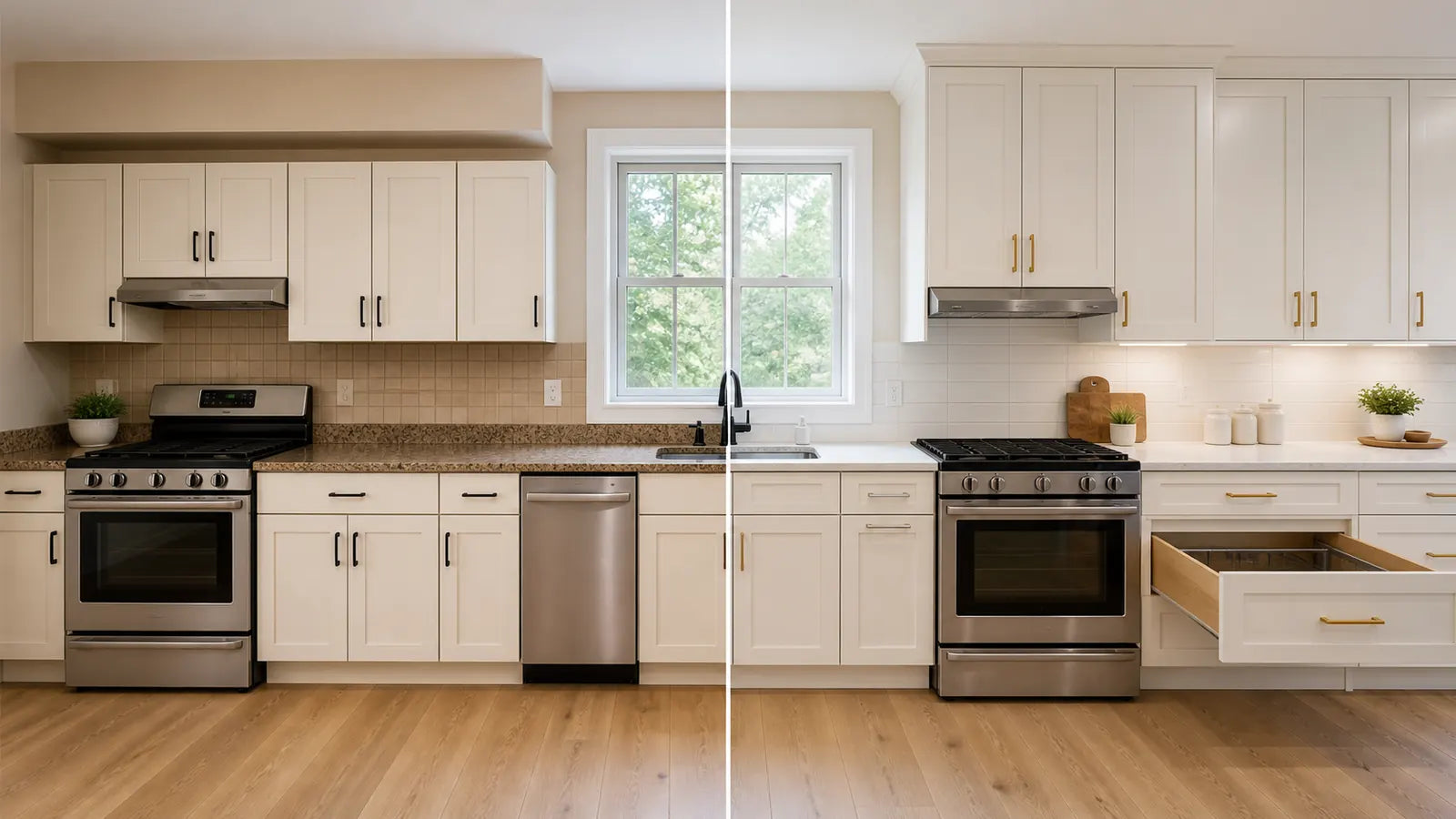
Your cabinet boxes are fine. The doors look dated. Somewhere between "leave it alone" and "gut the whole kitchen" sits a decision that will shape your budget more than any other choice in the project: reface the cabinets you have, or replace them entirely.
Almost every guide you will find on this question is published by a company that sells refacing. We sell and install new cabinetry, and we also tell customers to walk away from a replacement when refacing is the smarter buy. Here is the honest version of the comparison, with the numbers, the trade-offs, and the costs most articles skip.
The short answer
Reface when your cabinet boxes are solid wood or good plywood, the layout already works, and you mainly want a new look. Expect to pay roughly 30 to 50 percent less than full replacement and to be back in your kitchen within a week.
Replace when the boxes are particleboard or water-damaged, the layout frustrates you daily, you want deeper drawers or better storage hardware, or you are also changing countertops and appliances. New cabinetry costs more up front and buys you things refacing physically cannot deliver.
What refacing and replacing actually mean
The two terms get used loosely, and a third option gets mixed in, so it helps to separate them precisely.
| Option | What changes | What stays |
|---|---|---|
| Refacing | New doors, new drawer fronts, new hinges and hardware, plus a matching veneer or laminate skin applied to the exposed box frames and end panels | The cabinet boxes, the interior shelves, the layout, and usually the countertops |
| Refinishing | The existing doors and frames are sanded and re-stained or re-sealed. No new parts | Everything structural, plus the original doors and door style |
| Replacing | Everything cabinetry-related comes out. New boxes, doors, drawers, interior hardware, and often a new layout | Only the room itself |
One consequence matters more than any other: refacing locks in your current footprint. Every cabinet stays exactly where it is, at exactly the size it is. If that footprint is the reason you dislike the kitchen, refacing will not fix it no matter how good the doors look.
Check your cabinet boxes before you price anything
Refacing is only worth doing on boxes that will outlive the new doors. Spend five minutes on this before you call anyone.
- Look at a raw edge. Open a door and inspect the unfinished inside edge of the box. Layered stripes mean plywood. A dense, speckled, crumbly texture means particleboard or MDF.
- Press the cabinet floor under the sink. Any softness, swelling, or dark staining means water has already reached the substrate. Refacing seals a failing box behind a new face.
- Open and close every door and drawer. Doors that drop or bind often mean the frame is out of square or the screw holes are stripped. New hinges need sound wood to bite into.
- Push sideways on a wall cabinet. Noticeable racking means the box has lost rigidity.
- Pull a drawer all the way out. If it is a shallow box on plastic rollers rather than full-extension glides, refacing keeps that mechanism. Only replacement upgrades it.
Two or more problems on that list generally point toward replacement. A clean pass on all five means refacing is legitimately on the table.
What each option costs in 2026
Refacing pricing is quoted per linear foot of cabinetry, the same way new cabinetry is. Angi reported a 2026 national average of $7,233 for resurfacing a kitchen, with most projects landing between $4,484 and $10,588, or roughly $150 to $450 per linear foot. Material choice drives most of the spread: laminate and thermofoil fronts sit at the low end, wood veneer in the middle, and solid wood doors at the top.
New cabinetry spans a far wider band because the category itself is wider. Stock and ready-to-assemble lines commonly run $150 to $400 per linear foot, semi-custom lines $200 to $700, and full custom $500 to $1,200 and up, before installation. For the industry-standard 10x10 kitchen, that puts cabinetry somewhere between roughly $3,000 and $14,000 depending on the line you choose, with professional installation typically adding $1,500 to $3,000.
The National Kitchen and Bath Association puts cabinetry at close to 30 percent of a full remodel budget, which is why this single decision moves the total so much.
The comparison that actually matters
| Factor | Refacing | New cabinetry |
|---|---|---|
| Typical project cost | $4,500 to $10,500 | $4,500 to $17,000 installed, more for custom |
| Time on site | 3 to 5 days | 3 to 6 weeks, longer for custom orders |
| Kitchen usable during work | Mostly yes | No |
| Layout changes | Not possible | Fully possible |
| Interior storage upgrades | Very limited | Full range |
| Countertop replacement required | Usually not | Almost always |
| Expected service life | Tied to the age of the existing boxes | 20 years or more on quality boxes |
Why published refacing averages disagree by four times
This is worth understanding before you read any cost article, including this one. Thumbtack puts the national average for refacing at about $1,963. Angi puts it at $7,233. Both figures are real, and neither is wrong.
They measure different scopes. The low figures usually describe veneer applied to frames with the original doors reused, or a small galley with ten linear feet of cabinetry. The high figures describe new solid-wood doors, new drawer fronts, new soft-close hinges, and veneer across every exposed surface in a 25-plus linear foot kitchen.
So when you collect quotes, do not compare totals. Compare what is inside them: how many doors, how many drawer fronts, what the door material is, whether hinges and glides are new, and whether end panels and toe kicks are included. Two quotes $4,000 apart are frequently the same labor with a different parts list.
The costs most comparisons leave out
Refacing keeps your countertops, and that is a genuine saving. Replacement almost always means new countertops, because old slabs rarely survive removal intact and rarely fit a new box layout. That knock-on effect is where surprise spending appears, and it runs in both directions.
- Countertops. Replacing cabinets means budgeting for new quartz, quartzite, or porcelain countertops at the same time. If your existing counters are dated, this is a benefit rather than a cost, since you were going to replace them anyway. If they are nearly new, it is a real argument for refacing.
- Backsplash. Removing counters almost always damages the backsplash above them. New cabinet heights also change where the tile field starts and stops, so plan on new backsplash tile with a replacement.
- Sink and faucet. A new countertop means a new cutout. Undermount sinks in particular are bonded to the slab and rarely reusable, so a new kitchen sink usually joins the list.
- Flooring. Old cabinets often sit on flooring that was laid around them. Pulling them out can expose unfinished gaps or an older layer underneath.
- Electrical and plumbing. Moving a sink, adding an island, or relocating outlets are replacement-only projects and carry trade costs and permits.
- Interior hardware, on the refacing side. Soft-close glides, pull-out trays, and corner solutions depend on box dimensions. Retrofitting them into old boxes is sometimes impossible, and the cost of trying can close much of the gap to new cabinetry.
Our guide to the hidden costs of a kitchen renovation covers the wider version of this problem across the whole project.
What refacing cannot fix
Refacing is a cosmetic operation with a structural dependency. It will not:
- Change the layout, or move a sink, range, or refrigerator
- Make a 24-inch cabinet into a 36-inch cabinet
- Close the dead gap above wall cabinets, or take cabinetry to the ceiling
- Convert fixed shelves into deep pot drawers
- Repair a box that is already swollen, racked, or rotted
- Add an island, a pantry cabinet, or a built-in appliance surround
If the sentence in your head is "I wish there were more storage" or "the layout has never worked," those are replacement problems. If it is "the finish looks tired," refacing is the efficient answer.
How long each option lasts
Refaced doors and veneers on a well-built box hold up for years. The limiting factor is not the new face, it is the box behind it. Refacing a 25-year-old plywood box gives you a modern kitchen sitting on cabinetry that is already 25 years into its life. Quality new boxes start that clock over and typically carry a manufacturer warranty; refacing warranties usually cover only the parts that were installed.
This is the calculation that decides borderline cases. Refacing at 55 percent of the cost of replacement is excellent value on a sound box. On a marginal box, it is 55 percent of the cost for a fraction of the remaining life.
Timeline and living through the work
Refacing is usually a three-to-five-day job, and you keep a working sink and appliances through most of it. Replacement is measured in weeks: demolition, cabinet installation, then countertop templating, fabrication, and installation, which alone commonly adds one to three weeks between the boxes going in and the counters going on.
For households where losing the kitchen for a month is genuinely disruptive, that difference carries real value, and it is a legitimate reason to reface a kitchen that would otherwise justify replacement. Timing the work well helps either way, and our NJ kitchen renovation budget and timeline guide walks through how to sequence a project.
Resale value: which one pays back
Minor kitchen updates consistently recoup a higher percentage of their cost than major remodels, which is the strongest argument for refacing when you are preparing to sell. A smaller number returning 80 percent beats a larger number returning 60 percent if your horizon is short.
The logic reverses if you plan to stay. Percentage recouped stops being the point once you are buying a decade of daily use. Buyers also open drawers. A refaced kitchen with original 1990s interiors reads as a cosmetic update to anyone who looks past the doors, and appraisers and inspectors do look.
When refacing is the right call
- The boxes are solid wood or good plywood and pass the five-point check
- The layout works and you are not adding or moving anything
- Your countertops are recent or you like them
- You are selling within a year or two
- Losing the kitchen for weeks is not workable
- Your budget realistically tops out below what installed new cabinetry costs
When new cabinetry is the better investment
- The boxes are particleboard, swollen, or water-damaged
- The layout is the actual complaint
- You want deep drawers, pull-outs, a pantry cabinet, or cabinetry to the ceiling
- You are replacing countertops anyway, which removes the biggest saving refacing offers
- You are combining the work with new appliances or a plumbing change
- You intend to stay in the home for many years
- Quotes have come back close together, which happens more often than people expect once new doors, drawer fronts, hinges, glides, and veneer are all counted
If you land here, the next decision is which cabinet line fits the budget and the look. Our comparison of leading kitchen cabinet brands breaks down how the main manufacturers differ on construction and price, and the kitchen cabinet buying guide sorts the range by brand, color, and style.
Common mistakes we see in NJ and NY kitchens
- Refacing a kitchen with a bad layout. The most expensive version of this decision is paying for refacing, staying frustrated, and replacing three years later.
- Comparing quote totals instead of quote contents. Get the parts list in writing on both sides.
- Forgetting the countertop. Refacing usually keeps counters. Replacement usually does not. Price both projects complete, counters and backsplash included, rather than the cabinetry line alone.
- Ignoring the sink cabinet. It is the most common point of water damage and the one box that most often fails the inspection.
- Assuming refacing is always cheaper. Solid-wood doors, new drawer boxes, and full veneer coverage on a large kitchen can approach the installed cost of a stock or entry semi-custom line that would have been brand new.
- Choosing a door style from a photo instead of a sample. Finish reads differently under your own lighting. Take samples home either way.
How Home Craft Studio helps with this decision
We supply and install new cabinetry rather than refacing, so we will say plainly when refacing is the better buy for your kitchen. What we can do is give you an accurate picture of the replacement side so the comparison is fair.
Our designers work through layout, storage, and material selection with you at no charge, and you can book that as a showroom, in-home, or online design appointment. We carry six cabinet lines, including Fabuwood, TSG Forevermark, Shiloh, St. Martin Cabinetry, CNC Cabinetry, and J&K Cabinetry, which covers stock through semi-custom pricing. You can also browse new kitchen cabinets by brand, or narrow straight to shaker-style cabinets and white kitchen cabinets, the two most requested looks in tri-state kitchens.
For a working number before you commit to anything, request a kitchen price estimate based on your own measurements. Our installation service is handled in house, and financing options are available. Samples and full displays are on the floor at our showrooms in Clifton, North Bergen, and Newark, New Jersey, and Brooklyn, New York.
Frequently asked questions
What are the downsides of refacing?
Refacing cannot change your layout, cannot resize cabinets, cannot add storage the boxes do not already have, and cannot repair a damaged box. It also ties the life of brand-new doors to cabinetry that has already aged. On a sound box with a layout you like, none of those matter. On a failing box or a bad layout, all of them do.
Is cabinet refacing worth the money?
It is worth it when the boxes are structurally sound, the layout works, and your countertops are staying. In that situation you get most of the visual result for roughly 30 to 50 percent less than replacement, in days rather than weeks. It stops being worth it when the boxes are particleboard or water-damaged, or when the quote climbs close to the installed price of new cabinetry.
What is the average cost to reface a 10x10 kitchen?
A 10x10 kitchen is about 20 linear feet of cabinetry. At the $150 to $450 per linear foot range Angi reports for 2026, that works out to roughly $3,000 to $9,000, with laminate and thermofoil fronts at the low end and solid-wood doors at the high end. Published national averages vary widely because they measure different scopes, so treat any single figure as a starting point rather than a quote.
How long does cabinet refacing last?
The new doors, fronts, and veneer typically last many years. The practical limit is the existing box underneath, since refacing does not reset its age or condition. Refacing sound plywood boxes holds up well. Refacing boxes that are already deteriorating shortens the useful life of the work considerably.
Is refacing the same as refinishing or painting cabinets?
No. Refinishing sands and re-stains the doors you already have. Painting coats them. Refacing installs new doors and drawer fronts and applies new veneer to the frames, so it can change the door style itself. Refinishing and painting are cheaper and keep the original door profile; refacing costs more and changes the look.
Can I change my cabinet layout while refacing?
No. Every box stays where it is, at the size it is. Adding an island, moving a sink, widening a cabinet, or running cabinetry to the ceiling all require replacement.
Do I need new countertops if I replace my cabinets?
Almost always. Existing slabs rarely survive removal and rarely match a new box layout. Budget for new countertops alongside a cabinet replacement, and treat that as a point in favor of refacing if your current counters are new.
The bottom line
This decision is settled by the condition of your cabinet boxes and by whether the layout is part of the complaint, not by the headline price. Sound boxes plus a layout you like means refacing is real value. Failing boxes, or a layout that has always annoyed you, means refacing is money spent on the wrong problem.
If you want the replacement side priced accurately before you decide, bring your measurements to one of our showrooms or book a free design consultation. We will give you a straight answer, including the answer that says keep the cabinets you have.
Share:
Eco-Friendly Kitchen Renovation: Sustainable Cabinets, Low-VOC Finishes & Green Countertops
Floating Vanities, Warm Woods & Smart Mirrors: The 2026 Bathroom Vanity Playbook